I Built an AI Skill That Does My Least Favourite Part of SEO
I open sourced a Claude skill that turns any crawl export into a scored, prioritised technical SEO audit with platform specific fix instructions. It replaces the 6 hours of spreadsheet work after every crawl.
I have a confession. I love technical SEO. The crawling, the digging through server logs, the detective work of figuring out why Google is ignoring a page that should be ranking.
That part is genuinely fun.
What I do not love is what comes after the crawl.

You know the bit.
You have just finished a Screaming Frog export. 50,000 rows of data staring at you. And now you need to spend the next 2 hours turning that into something a client can actually use.
Categorising. Prioritising.
Writing fix instructions.
Formatting a spreadsheet with colour coded severity levels.
It is the SEO equivalent of doing your taxes.
So I built a Claude skill that does all of it automatically. And then I open sourced it because I am apparently incapable of keeping things to myself.
What the skill actually does
The skill sits on top of whatever crawl data you already have. Screaming Frog, Sitebulb, Ahrefs Site Audit, Firecrawl, or honestly any CSV with URL and status columns. It does not replace your crawler. It replaces the 6 hours of spreadsheet work that comes after.
Here is the pipeline:
1. Data normalisation. It auto detects which crawl tool you used by reading column headers and maps everything to a standard schema. Screaming Frog’s Status Code becomes the same field as Sitebulb’s HTTP Status. You do not need to think about it.
2. Platform detection. It reads URL patterns, meta generator tags, and response headers to figure out if you are running WordPress, Shopify, Magento, or something custom. This matters because the fix instructions need to be platform specific. “Edit your .htaccess” is useless advice for a Shopify store.
3. Analysis across 10 categories. Crawlability, indexability, on page elements, site architecture, performance, mobile readiness, structured data, security, international SEO, and AI readiness. Each category has multiple specific checks.
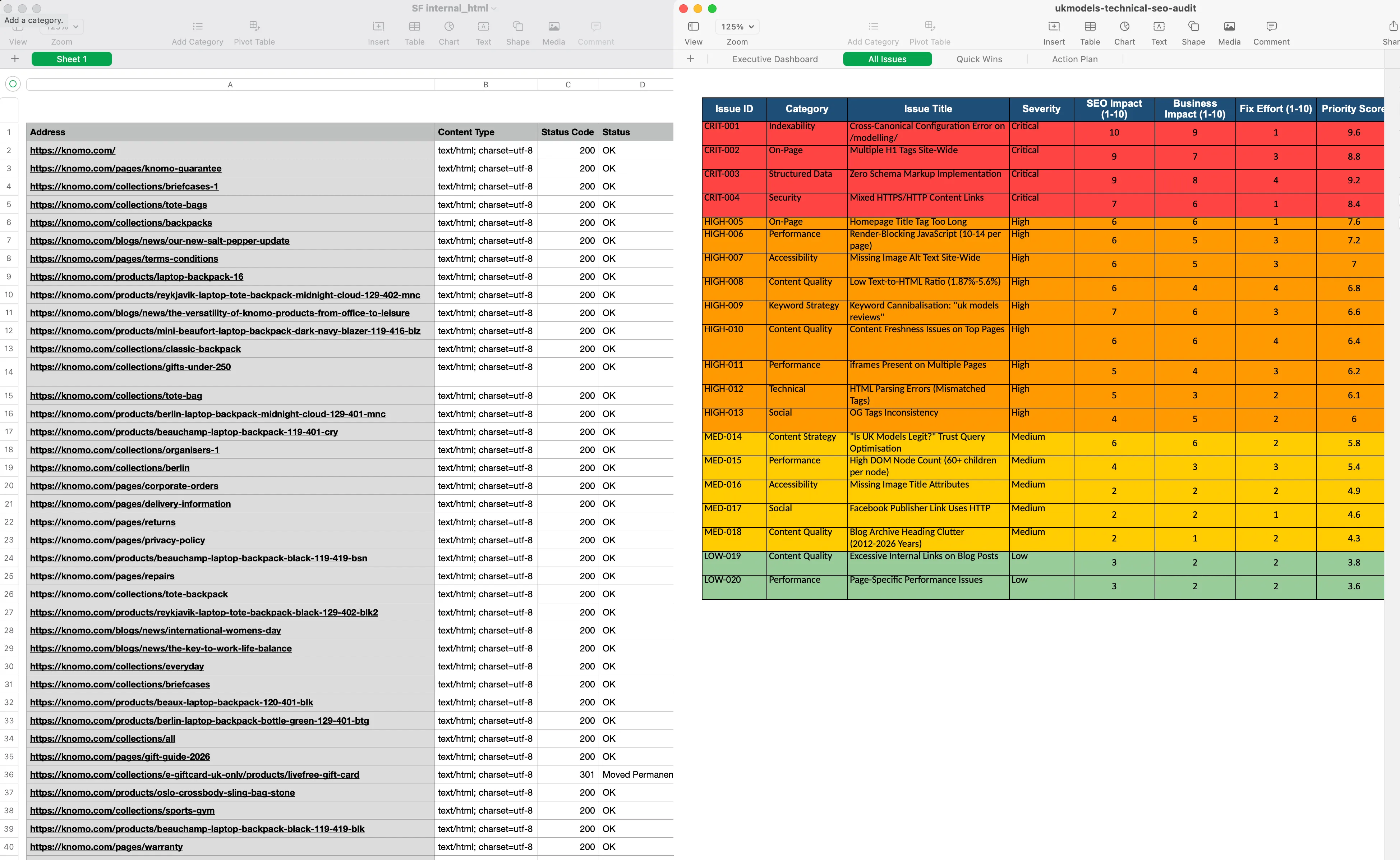
4. Three dimensional scoring. Every issue gets scored on SEO Impact (1 to 10), Business Impact (1 to 10), and Fix Effort (1 to 10). The priority formula is:
Priority = (SEO Impact × 0.4) + (Business Impact × 0.4) + ((10 − Fix Effort) × 0.2)This is the bit I am most proud of. A missing alt tag on a blog post from 2019 and a broken canonical on your highest revenue page are not the same severity, even though most audit tools treat them that way. The business impact dimension changes everything.
5. Two deliverables. A Markdown report with executive summary, categorised findings, and strategic recommendations. Plus an XLSX spreadsheet with every issue, priority score, affected URLs, fix instructions, and an implementation timeline. Both generated in minutes.
The finding that sold me on this approach
The first time I ran the skill on a random site, it flagged something interesting. A canonical tag on their /modelling/ page (which ranks #1 for “modelling” with 5,200 monthly searches) was pointing to the homepage instead of itself.
One misconfigured line of code was actively telling Google to ignore one of their most valuable pages.
Priority score: 9.6 out of 10. High SEO impact, high business impact, near zero fix effort.
A human analyst would probably catch this eventually. But it would be buried in the spreadsheet somewhere around row 847.
The skill surfaced it as the number one priority in seconds, with a platform specific fix instruction explaining exactly where to change it.
The technical bits
The skill is a Claude skill, which means it runs inside Claude Desktop (Cowork mode) or Claude Code CLI. If you are not familiar with Claude skills, they are essentially instruction files that give Claude specialised capabilities and methodology for specific tasks.
The installation is straightforward. For Desktop, you drop the skill folder into .skills/skills/ inside your working directory. For CLI, it goes in .claude/skills/. Then you just tell Claude to run a technical SEO audit and point it at your data.
your-working-folder/
└── .skills/
    └── skills/
        └── technical-seo-audit/
            ├── SKILL.md
            ├── references/
            │   ├── analysis-modules.md
            │   ├── impact-scoring.md
            │   ├── api-crawling.md
            │   └── data-ingestion.md
            └── scripts/
                └── analyse_crawl.py
If you want supplementary data from Ahrefs or DataForSEO (keyword volumes, competitor data, backlink metrics), set the API keys as environment variables:
export AHREFS_API_KEY="your_key"
export DATAFORSEO_LOGIN="your_login"
export DATAFORSEO_PASSWORD="your_password"
But this is entirely optional. The skill works perfectly well with just a crawl CSV upload.
Why open source it
At Snippet Digital (my agency), we have been building AI into our SEO workflows since the early days of Claude.
This skill is one of the tools that has had the biggest impact on our efficiency. So naturally, the question was: why give it away?
Because the skill is not the competitive advantage. The strategic thinking is.
Understanding why a canonical misconfiguration matters more on a revenue page than a blog post.
Knowing how to prioritise a 4 week implementation plan for a client with limited dev resources. Connecting technical findings to actual business outcomes.
That is what clients pay for.
The mechanical work of turning a CSV into a formatted, scored, categorised spreadsheet? That was never the value. It was just the bottleneck.
Try it yourself
The full repo is here: github.com/Suganthan-Mohanadasan/tech-seo-audit-skill
There is a detailed write up with cost comparisons and a step by step installation guide on the Snippet Digital blog: snippet.digital/blog/technical-seo-audit-ai-process/
If you improve it, send a PR. If it breaks, open an issue. If it saves you 2+ hours on your next audit, maybe buy me a coffee.
You might also like
Stay in the loop
I'll email you when I publish something new. No spam. No fluff.
Join other readers. Unsubscribe anytime.

Entrepreneur & Search Journey Optimisation Consultant. Co-founder of Keyword Insights and Snippet Digital.