How to Get a Google Search Profile From Outside the US
Google Search profiles are US only for now, but you can open yours from anywhere today. Here is how, plus how claiming works and the noindex catch nobody mentions.
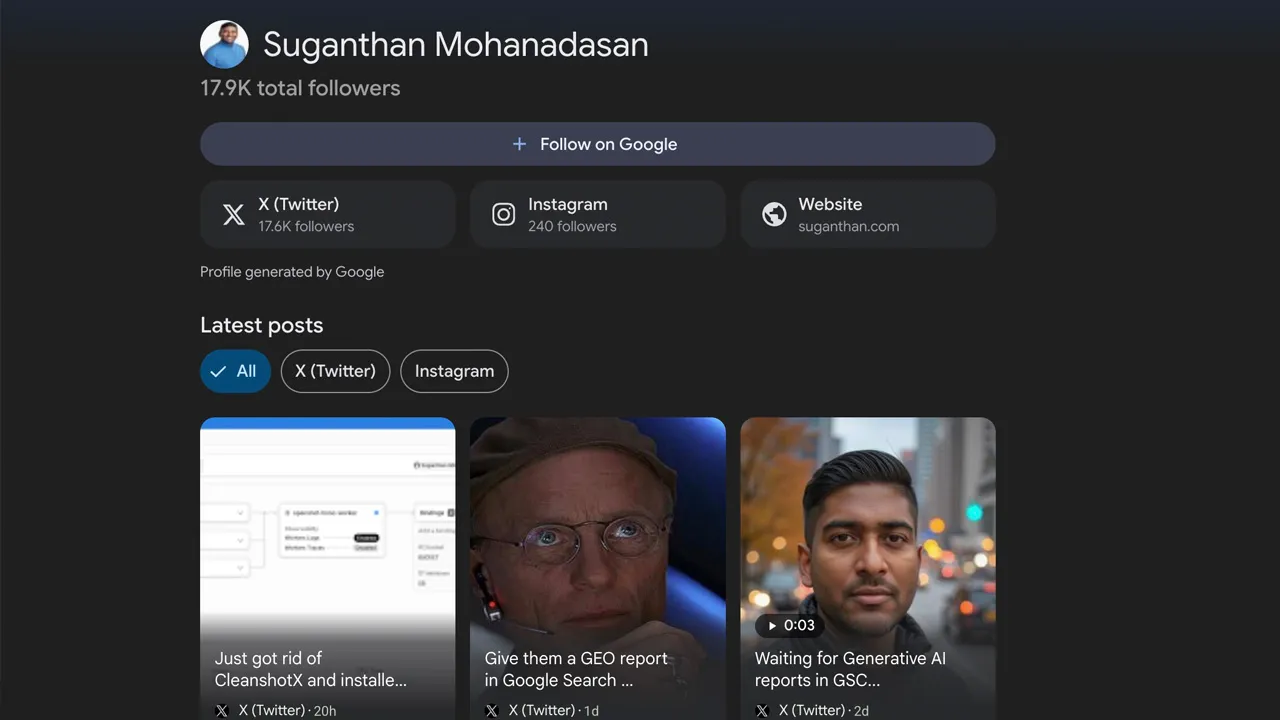
Update (19 June 2026): A slide from Search Central Live in Milan has me asking whether a Search Profile and a Knowledge Panel are 2 separate things or quietly merging into one. Short note below.
Update (10 June 2026): Added the 2 profile types, the actual claim flow, the new Insights analytics, the 19 year history behind this feature, and a catch I verified myself. Unclaimed profiles carry a noindex tag, so Search will not surface them until claimed. Drawn from public threads by Cyrus Shepard, Lily Ray and Nick LeRoy.
Google launched Search profiles on 4 June 2026, in the US only. I live in Dubai. Mine is already live.
The reason this works is simple. The profile page for any entity already sits at a fixed Google URL, whether or not the feature has officially reached your country. If Google has an entity for you, even without a Knowledge Panel, you can open your profile today, no VPN required.
Here is the whole method. It takes about 2 minutes.
What a Google Search profile is
A Search profile is a page Google gives a creator or publisher to represent themselves across Search. An avatar, a short bio, a link to your site, your social accounts, and the work Google associates with your name. It is the closest thing to a verified profile that Google itself owns, rather than X or LinkedIn.
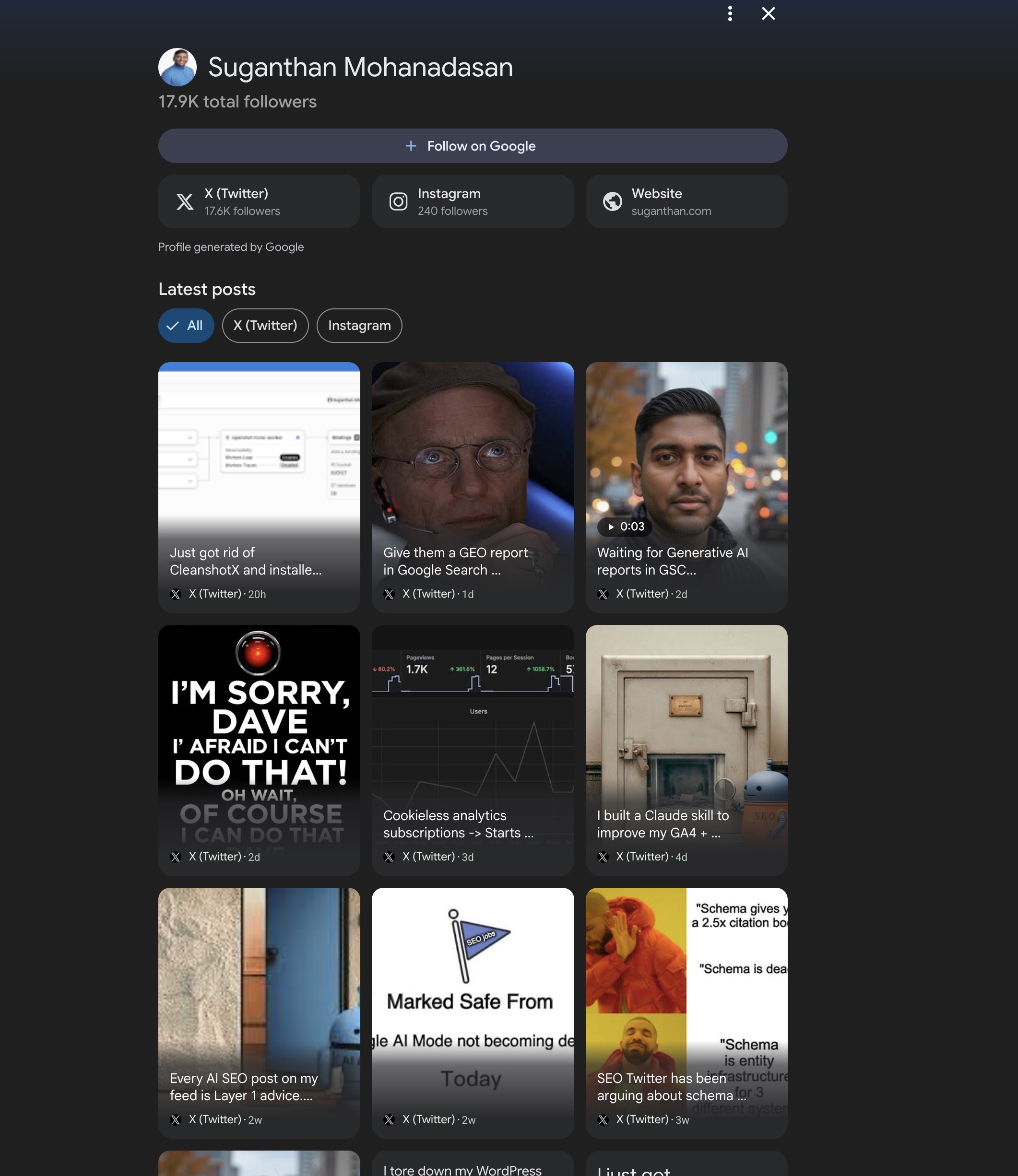
Here is mine, a live one you can open right now.
What Google announced
Google announced Search profiles on 4 June 2026. Anyone with a sizable following on at least one major social or video platform can claim one and customise it with a bio, a website, and their social links. You do not even need an existing Knowledge Panel to claim a profile, and claiming one can prompt Google to build a panel for you.
It is US only for now
The catch is one line in that announcement. Search profiles “will initially launch in the US.” Google names no other countries and gives no timeline. So if you sit outside the US, the official claim flow is shut to you for now.
You do not have to wait
Here is the part Google does not advertise. Every Search profile lives at a fixed URL built from the entity’s Knowledge Graph ID, the KGMID. Once Google has generated your profile, that URL opens from anywhere. Dubai, Lagos, Manila, it makes no difference.
Credit where it is due. I picked this up from Nathan Jeffery and Jes Scholz, who worked out how the profile URLs are put together.
What you need first
The requirement is simple. Google has to have an entity for you. A Knowledge Panel is the obvious sign of one, but you do not need a panel. Google now generates entities for plenty of people off their social presence alone, no website required.
Then there is the Google Search Profile URL generator I built, which turns that entity into your profile link.
Just search your name
Open the Google Search Profile URL generator and type your name or brand. It queries Google’s Knowledge Graph, ranks the matching entities by Google’s own relevance score, and builds a profile link for each. The right person is usually the top result, and every row now carries a type badge and a short description, so same-name strangers are easy to tell apart. If you share a name with half of LinkedIn, type a job, city or company into the narrow box and the list filters down to the right entity. Find yourself, click Open profile, and there it is. This is the path to use if you have no Knowledge Panel, because it surfaces the entity Google made for you whether or not a panel ever showed up.
If you already have your link or ID
If you do have a Knowledge Panel, there is a more direct route. Search yourself on Google, click Share, and paste the share.google/... or g.co/kgs/... link into the link tab of the tool. It reads the KGMID out and builds your profile URL. A raw KGMID works too, the /g/11nnv1wqs6 or /m/03j24kf kind, as does any Google search URL with a kgmid= parameter.
Either way the conversion is deterministic, not a hack. The tool wraps your KGMID in a small Protobuf message, Base64 encodes it, and appends it to Google’s base profile URL, so the same entity always produces the same link.
There are 2 kinds of profile
Within days of launch, Cyrus Shepard claimed his, Lily Ray got hers approved, and Nick LeRoy noticed his behaved nothing like theirs. Comparing them side by side reveals a fork Google has not documented anywhere I can find.
A claimed creator profile lives at a handle URL, like profile.google.com/@cyrusshepard. The owner controls the avatar, the bio, the website links and the connected socials. Claiming is what converts the URL into that form.
An auto-generated entity profile lives at the /cp/ URL this post shows you how to open, built from your Knowledge Graph ID. Mine is one of these. You cannot edit it. The 3 dots menu offers Suggest feedback and nothing else, which Nick discovered after hunting for an edit button that does not exist.
The difference that matters is invisible. I checked both kinds on 10 June 2026. My unclaimed profile serves this line in its page head, while Lily’s claimed profile carries no robots restriction at all.
<meta name="robots" content="noindex">Until you claim, your profile is a page Google itself declines to index. You can open it and share it, and Search will never show it to anyone. Credit to Nick for spotting the split.
The unclaimed version is still not an empty shell. Nick’s pulls in his latest X posts automatically, and mine lists the work Google associates with my name. Google is populating these in the background whether you participate or not.
Who actually gets one
There are 3 ways to end up with a profile, and the gaps between them are the interesting bit.
The first is to claim one yourself, which needs a large following. Google has published the bar. You need to be at least 18, based in the US, and have 100,000 followers on YouTube, Instagram or X, or 300,000 on TikTok, with content that meets its guidelines. The in-product claim screen shows the same numbers, so the published bar and the enforced bar match. LinkedIn isn’t on the list, which fits how Google has always treated it in the Knowledge Graph.
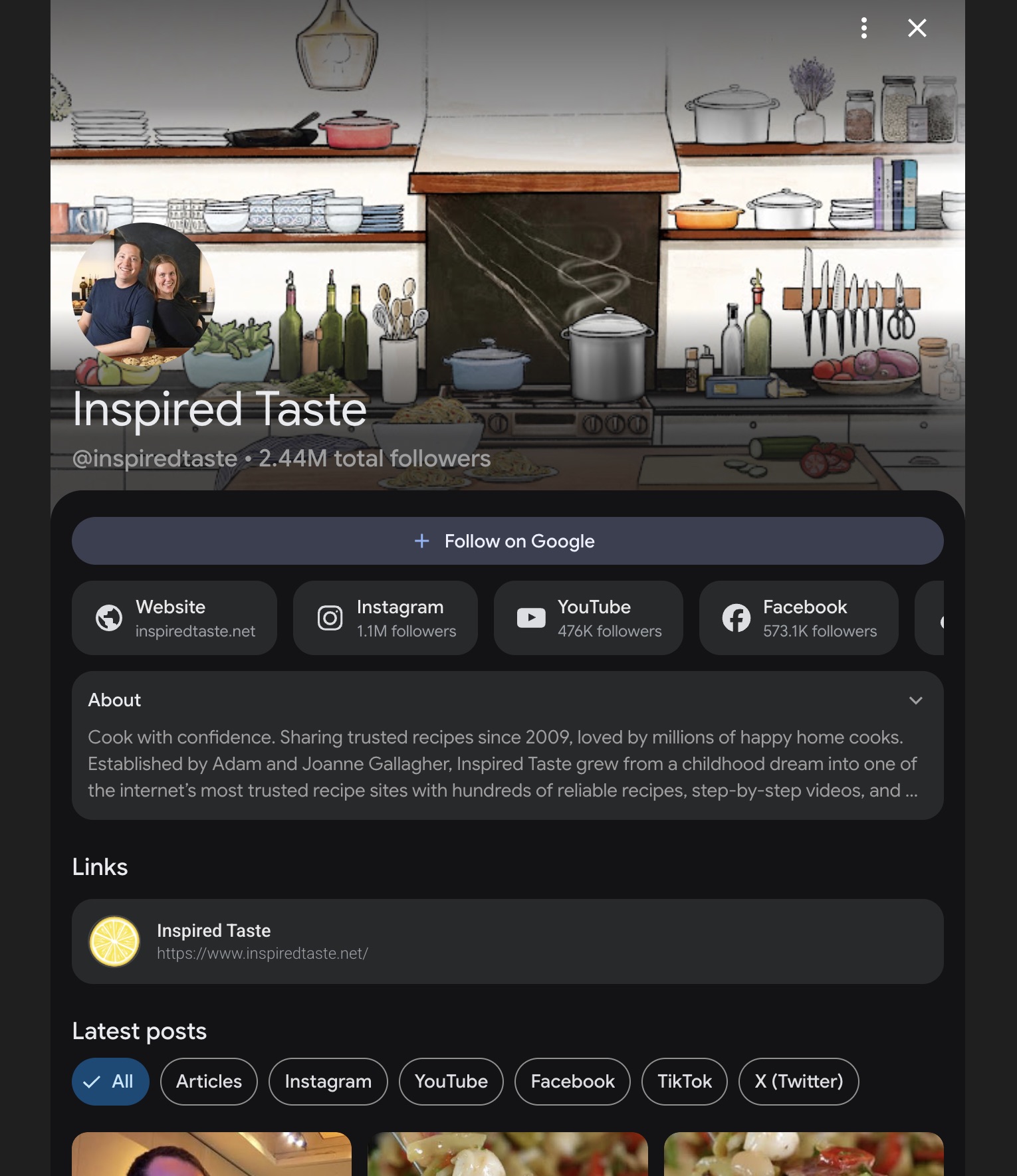
The Inspired Taste blog is a good example, a profile claimed on follower numbers alone.
The second is to already exist as an entity. If Google recognises you in its Knowledge Graph, a Knowledge Panel being the obvious sign, it may have auto-generated a profile for you. Its own docs even tell you to check whether it has “already generated one based on your online presence” before creating one.
This is how I got mine. Because I don’t live in the US, I’m unable to claim or make any edits yet.
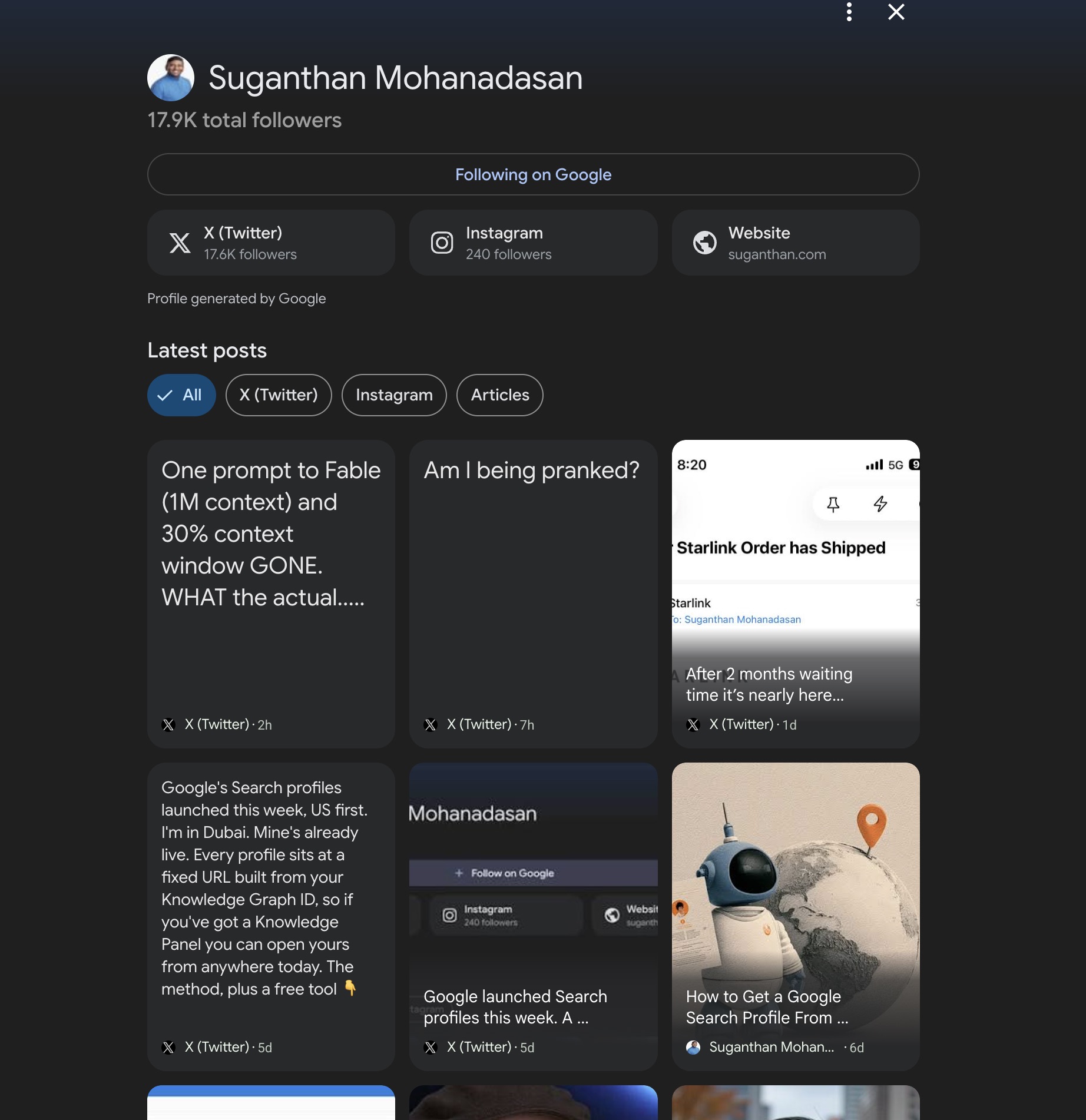
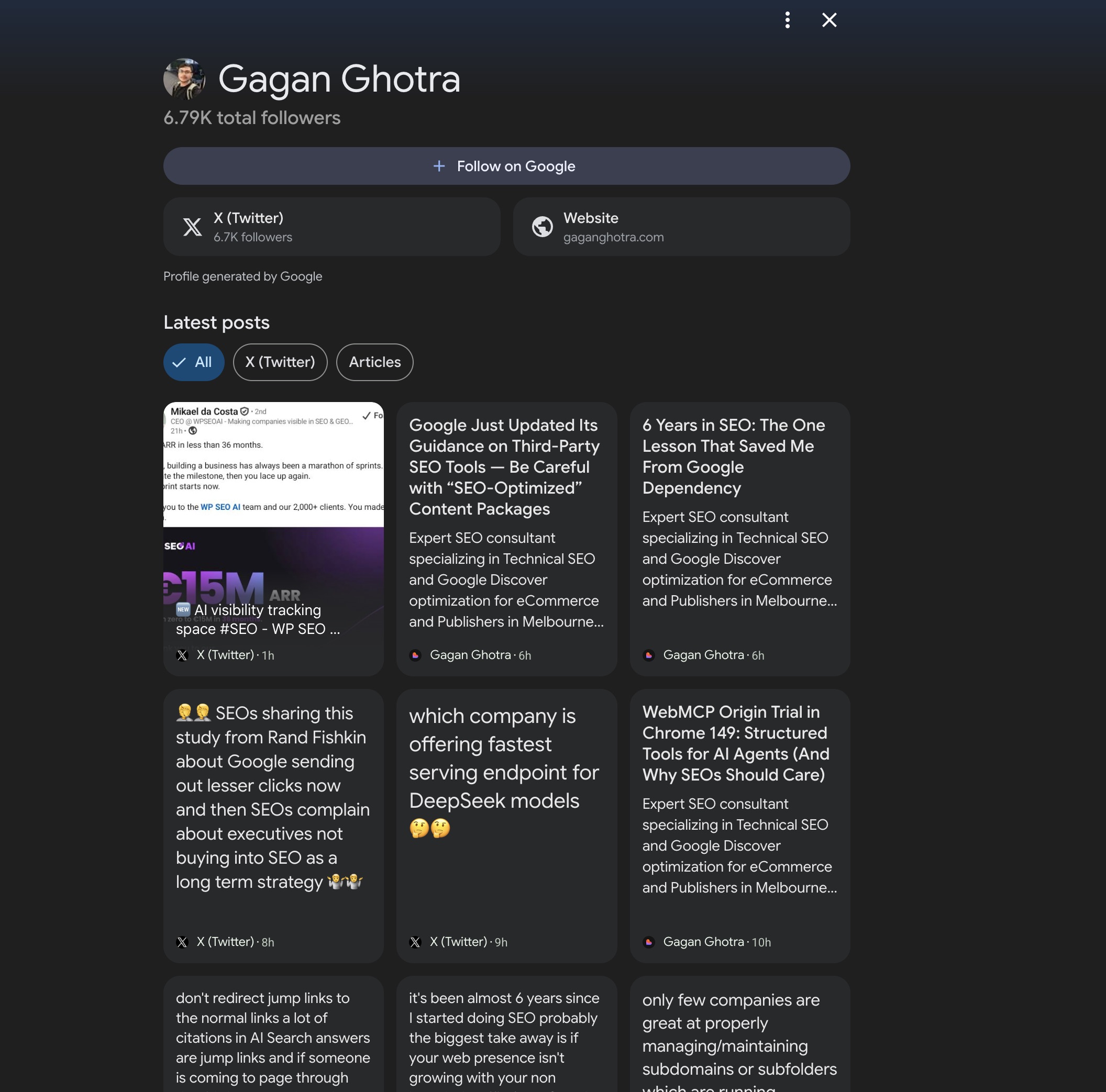
The third is the strange one, and it might be a glitch. I’ve seen profiles for people who have no Knowledge Panel and are nowhere near the follower numbers, just a solid social presence and nothing else. Google still minted them an entity and a profile. Either there is a softer signal at work than the published bar, or the rollout is seeding profiles it shouldn’t. Either way, if those numbers feel out of reach, search your name anyway. Google may well have already made you one.
Here is one, the Search profile of an SEO who is active on socials but has no Knowledge Panel and nowhere near the follower bar.
How to claim yours
If you clear the bar and you are in the US, the process comes from Cyrus, who answered when I asked him directly in his thread. His verdict was “they don’t make it easy”.
Check your eligibility at profile.google.com/claim. The entry points are creators.google/profile and profile.google.com/account.
Sign in with 1 social account that meets the minimum audience size. That account is your proof of eligibility, and a Google Account can only ever claim 1 profile. Cyrus ran into that wall on a second attempt, where the screen reads “A Google Account can only claim one profile”.
Expect the edits to crawl. The UI promises changes within 24 hours, but Cyrus added several websites that sat in approval for days, and Lily’s extra social profiles were still pending when she announced hers.
Below the thresholds there is no claim path at all. Nick, at 8.5K followers on X, signs in and gets a generic reviews profile, the kind where Google invites you to rate films. The claim flow only appears for accounts that already qualify.
For those of us outside the US, the geography gate sits in front of all of this. The claim URLs load fine from Dubai and funnel straight into a Google sign in. Whether a non US account passes once signed in is the part I cannot test, because I sit under the follower bar on every qualifying platform anyway. 17.6K on X does not move Google.
Claimed profiles come with analytics
Google is already testing an Insights panel on Search profiles. Jane Manchun Wong surfaced the beta screens, and Barry Schwartz confirmed it on 9 June 2026 by finding it live on his own claimed profile. It reports your top 5 posts on Search ranked by clicks, your total clicks and impressions from Google, and the countries your clicks come from.
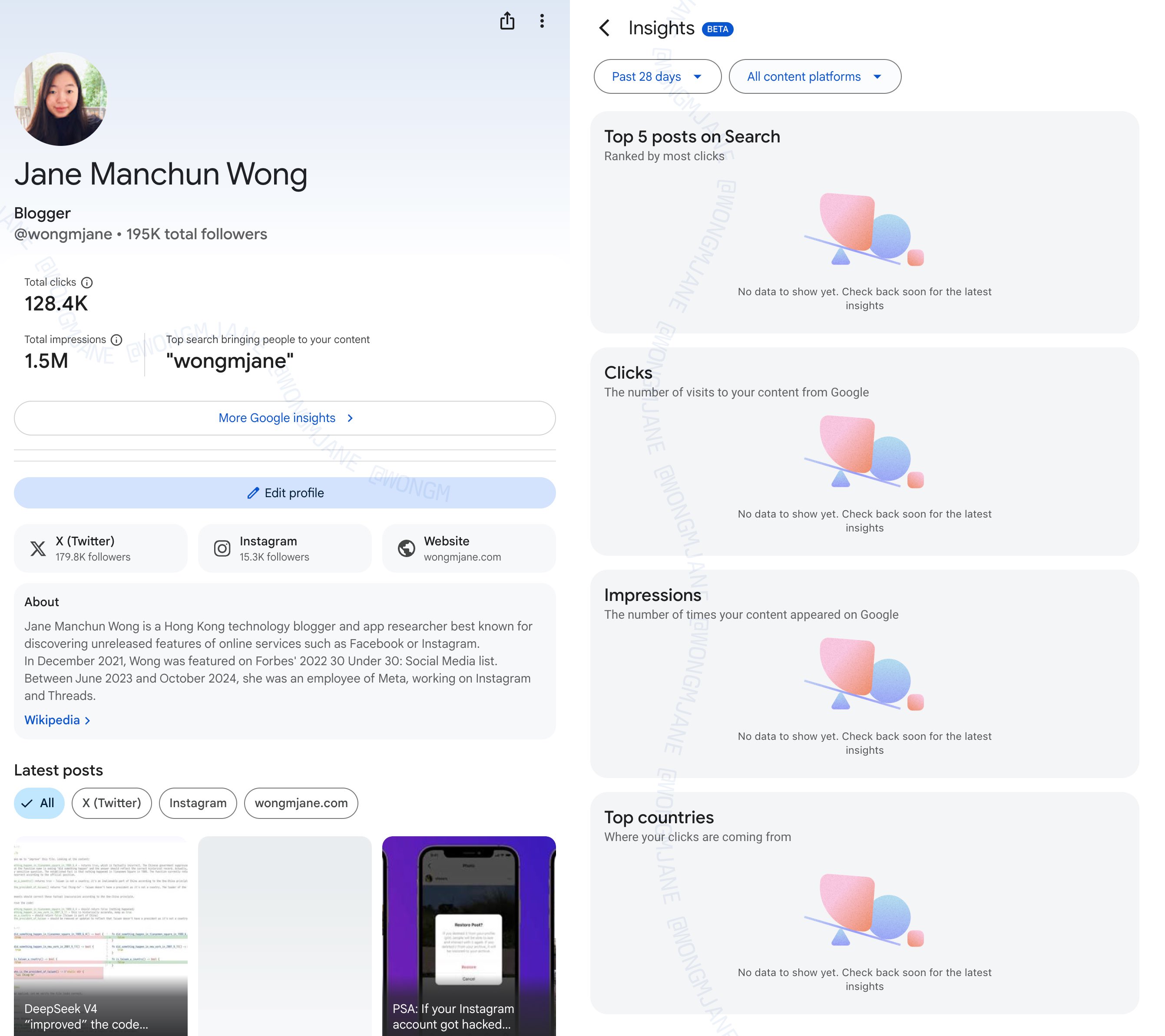
That list deserves a second look. Clicks, impressions and country data for you as a person, separate from any website you own. It is Search Console for your entity rather than your domain, and Google has never offered that surface before.
The panel sits inside the claimed profile dashboard, so the same gates apply, the follower bar and, for now, the US.
Knowledge Panel vs Search Profile
Stefano shared a slide from Search Central Live in Milan on 18 June 2026, and it has me looking again at where one ends and the other begins.
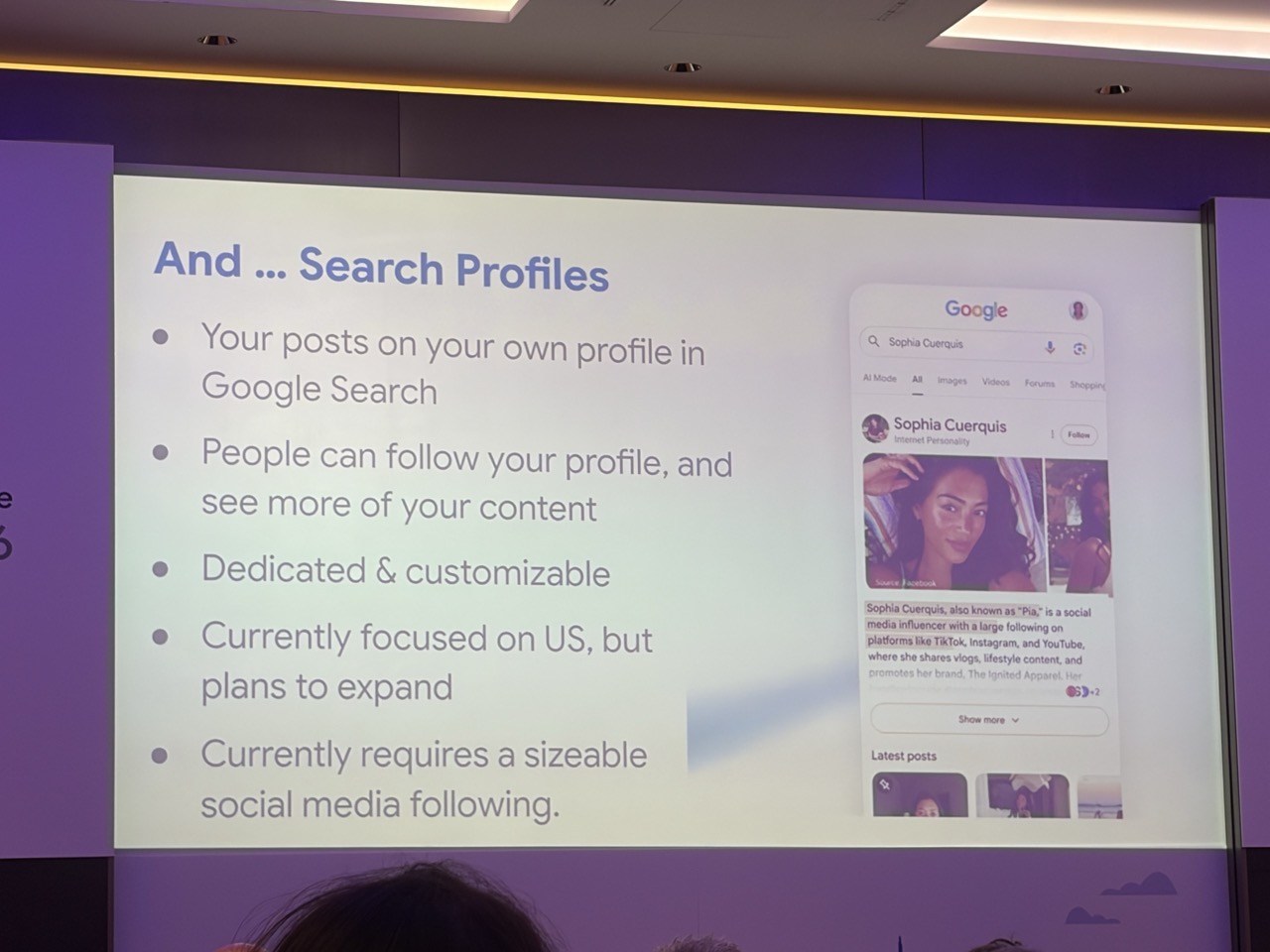
A Knowledge Panel is the box Google assembles about an entity from its Knowledge Graph. A Search Profile is the page Google automatically creates based on a large social media following which you claim and customise yourself. Google has said that creating a profile can lead to a panel, which makes the profile sound like a way in, not the panel itself.
The slide backs that up. It shows a Search Profile sitting inside the results with a Follow button and a row of latest posts, which is not how a Knowledge Panel usually looks. From what I can see they are still 2 separate things, with the profile acting as the route into a panel. Whether Google keeps them apart or merges them, I cannot tell yet. Keeping an eye on this one.
What I think Google is trying to do
My take is entity disambiguation. There are thousands of Suganthans across Sri Lanka and India. Some are scientists. At least one dances on TikTok. When someone searches the name, Google has to work out which of us they mean, and the only reliable way is to anchor each name to verified accounts, a face, and a body of work. A Search profile is exactly that anchor, and you assemble it for free. The profile is the visible front end. The disambiguation is the part Google actually wants.
I’m fairly confident in that reading because Google has been chasing it for 19 years, and the graveyard is crowded.
Google Profiles arrived in 2007, a standalone identity page that later got swallowed by Google+. Then came Authorship in 2011, the rel=author era, which linked articles to your Google+ profile and put author photos in the results. The photos went in June 2014, the programme died that August, and Google+ itself limped on until April 2019.
Knowledge Panel verification followed in June 2018, and survives today, but claiming a panel only earns you the right to suggest edits that Google may or may not accept.
Then the closest ancestor. People Cards, the “add me to search” feature, launched in India in 2020 and expanded to Kenya, Nigeria and South Africa. Anyone could make one, no notability bar at all. Google killed it on 7 April 2024, and the farewell email admitted “this feature wasn’t as helpful for people as we hoped”.
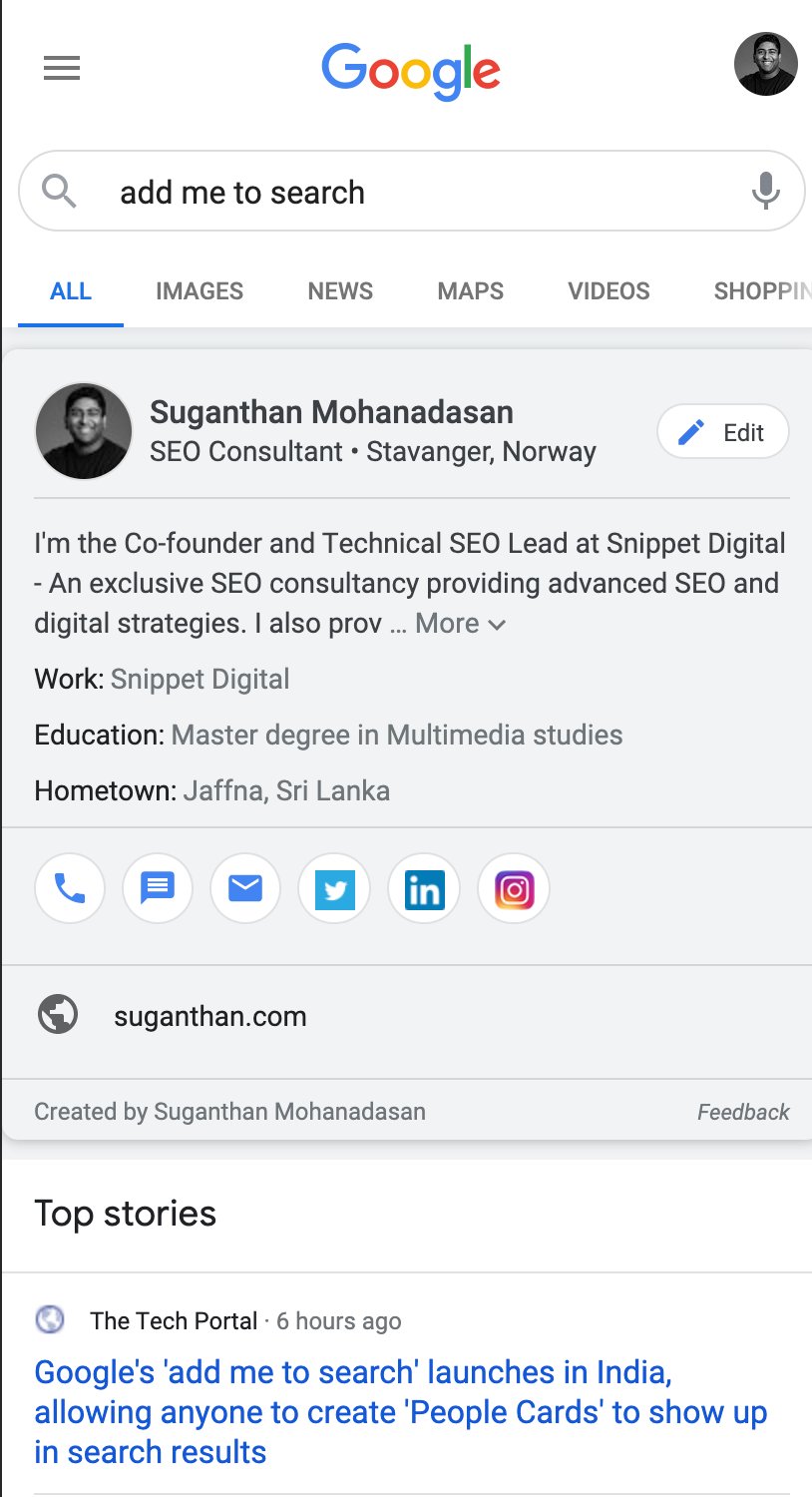
Search profiles read like the same play with 2 lessons learned. People Cards had no bar and filled with junk, hence the follower thresholds this time. And every earlier attempt asked you to do the work while offering nothing back. This time there is a bribe. Analytics, a follow button, and a profile page Google will actually index. Meanwhile the Knowledge Graph has stopped waiting for volunteers, my unclaimed page exists whether I participate or not. The carrot is new. The goal has not moved since 2007. One verified identity per human, so Search knows exactly which Suganthan you meant.
3 honest caveats
A quick honesty check, so nobody emails me disappointed.
First, this opens a profile that Google has already generated. It does not conjure one out of nothing. If your entity is thin or brand new, the URL might not show a full profile yet.
Second, the full claim and customisation flow, the part where you edit your avatar and bio, is still inside the US rollout. What you get today is early access to the profile page itself. For most of us outside the US, seeing the profile and checking Google has the entity right is the useful part.
Third, added in the 10 June update. The profile this method opens is noindexed until claimed. My own page head carries a robots noindex tag, while claimed profiles like Lily Ray’s carry none. Treat yours as a mirror rather than a megaphone. It shows you what Google believes about you, and nobody will find it through Search until the claim flow reaches your country and your follower count.
The global rollout will almost certainly follow, the way these US first launches usually do. Until then, if Google has an entity for you, there is no reason to wait to see yours.
Want my posts to show up more often on Google?
One click and Google will surface this site in your Top Stories.
Norwegian entrepreneur with 20+ years in SEO. Co-founder of Keyword Insights and Snippet Digital. Based in Dubai.